Key Takeaways
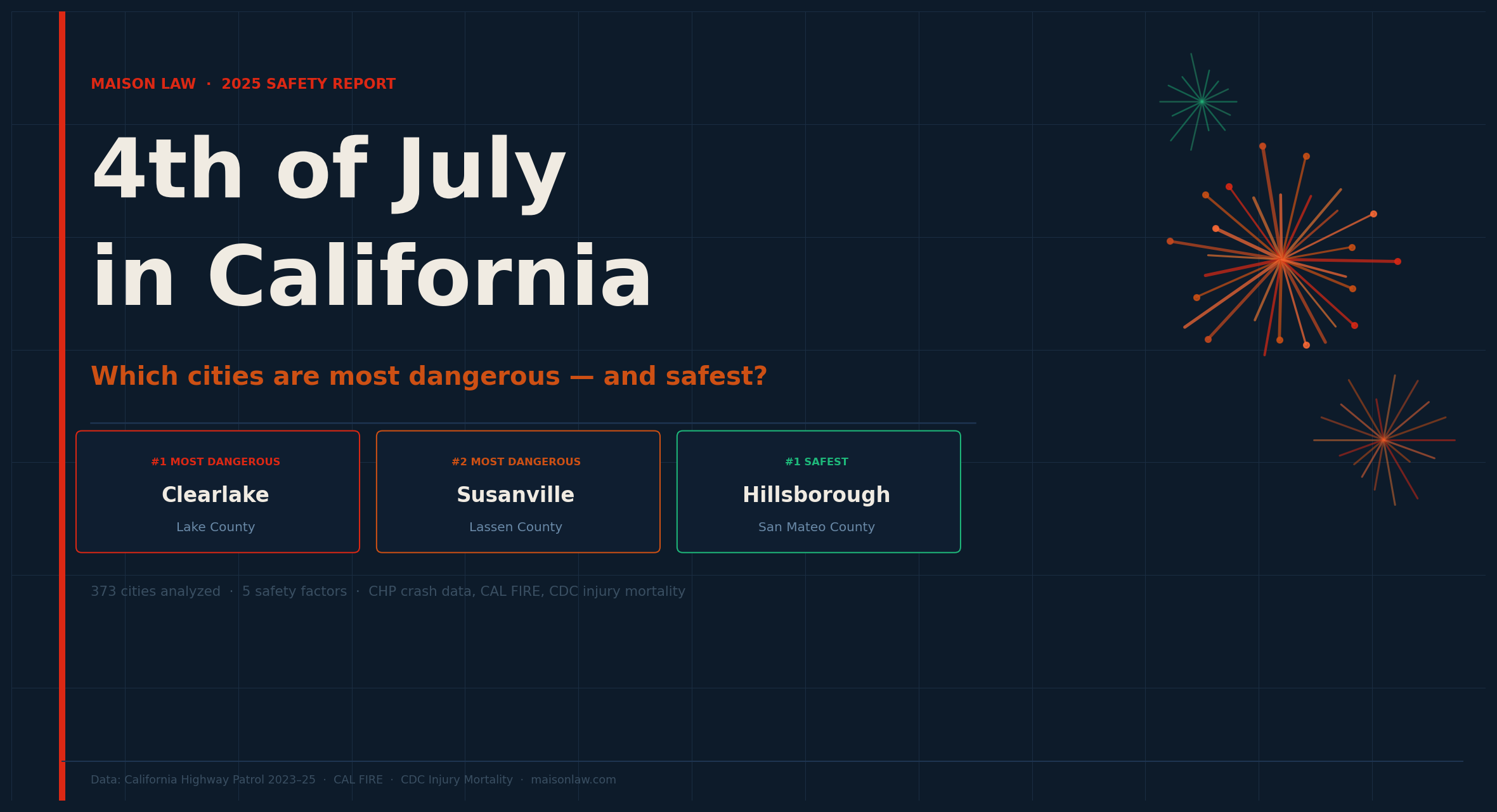
- Clearlake, Susanville, and Red Bluff rank as the three most dangerous California cities for Fourth of July based on crash rates, injury deaths, fire risk, and fireworks retail access
- Sacramento, Modesto, Bakersfield, and other major Central Valley cities rank in the top 20 most dangerous — a pattern consistent with California’s broader traffic safety struggles
- Hillsborough, Rancho Palos Verdes, and Lomita are the state’s safest cities for the holiday weekend
- 373 California cities with populations over 10,000 were analyzed across five safety factors
- California’s 2026 DUI laws are the strictest in state history — the legal and financial consequences of a holiday DUI are more severe than most people realize
Why the Fourth of July Is One of the Most Dangerous Days on California Roads
The Fourth of July is not just a holiday. It is consistently one of the deadliest days of the year for drivers, pedestrians, and bystanders across California.
Alcohol-impaired driving spikes. Illegal fireworks start fires in drought-stressed communities. Residential streets fill with distracted drivers who haven’t thought much about their route home. And in 2025 alone, California saw another dangerous holiday weekend add to three years of troubling data.
To give Californians a clearer picture of where the risk is highest — and where it’s lowest — Maison Law analyzed data across five safety categories for 373 California cities. Here’s what we found.
The Rankings: Most Dangerous California Cities for Fourth of July
Top 10 Most Dangerous Cities
| Rank | City | County |
|---|---|---|
| 1 | Clearlake | Lake |
| 2 | Susanville | Lassen |
| 3 | Red Bluff | Tehama |
| 4 | Malibu | Los Angeles |
| 5 | Signal Hill | Los Angeles |
| 6 | Eureka | Humboldt |
| 7 | Oroville | Butte |
| 8 | Marysville | Yuba |
| 9 | Modesto | Stanislaus |
| 10 | Beverly Hills | Los Angeles |
Clearlake (Lake County) tops the list, driven by a high county-wide injury death rate, elevated crash averages, and one of the highest fire incident rates in the state — Lake County has recorded more fires per 100,000 residents than almost any county in California.
Susanville and Red Bluff follow closely. Both sit in Northern California counties with extreme wildfire exposure (Lassen and Tehama counties, respectively) and above-average crash mortality rates. Tehama County’s fire incident density is more than 150 per 100,000 residents — nearly 15 times higher than Los Angeles County.
Malibu and Signal Hill appear in the top five despite being Los Angeles County cities with relatively low county-level fire risk. What pushes them up: extraordinarily high five-year crash averages relative to their small resident populations. Malibu sees nearly 1,000 crash fatalities and injuries per 100,000 residents in an average year, a figure that reflects its role as a heavily trafficked coastal corridor rather than a quiet residential enclave.
Several major Central Valley cities — Modesto, Bakersfield, Sacramento, Stockton — rank in the top 25. These are not surprise findings. California’s Central Valley has some of the state’s highest per-capita crash rates year-round, and Fourth of July weekend amplifies that baseline.
The 25 Most Dangerous Cities (Full List)
| Rank | City | County | Population |
|---|---|---|---|
| 1 | Clearlake | Lake | 15,000 |
| 2 | Susanville | Lassen | 13,700 |
| 3 | Red Bluff | Tehama | 14,500 |
| 4 | Malibu | Los Angeles | 12,000 |
| 5 | Signal Hill | Los Angeles | 11,500 |
| 6 | Eureka | Humboldt | 27,000 |
| 7 | Oroville | Butte | 19,000 |
| 8 | Marysville | Yuba | 12,000 |
| 9 | Modesto | Stanislaus | 220,000 |
| 10 | Beverly Hills | Los Angeles | 34,109 |
| 11 | Truckee | Nevada | 16,000 |
| 12 | Sacramento | Sacramento | 524,000 |
| 13 | Colton | San Bernardino | 56,000 |
| 14 | Redding | Shasta | 93,000 |
| 15 | Paradise | Butte | 10,000 |
| 16 | Montclair | San Bernardino | 38,000 |
| 17 | Arcata | Humboldt | 18,197 |
| 18 | Downey | Los Angeles | 113,000 |
| 19 | Bakersfield | Kern | 407,000 |
| 20 | San Bernardino | San Bernardino | 220,000 |
| 21 | Riverbank | Stanislaus | 25,000 |
| 22 | South Lake Tahoe | El Dorado | 22,000 |
| 23 | Lathrop | San Joaquin | 30,000 |
| 24 | Ukiah | Mendocino | 16,000 |
| 25 | Calimesa | Riverside | 12,000 |
The Rankings: Safest California Cities for Fourth of July
San Mateo County dominates the safest end of the list. Cities like Hillsborough, Belmont, Redwood City, and Daly City benefit from low county-wide fire exposure, below-average injury death rates, and relatively few crashes during the holiday window.
Rancho Palos Verdes and Lomita in Los Angeles County are notable exceptions to that county’s generally elevated crash risk — both saw minimal Fourth of July crash activity across the 2023–2025 study period.
Several Orange County cities also rank among the safest: Aliso Viejo, Rancho Santa Margarita, Yorba Linda, and Lake Forest. These are cities with relatively low traffic volumes, limited wildfire exposure, and few fireworks retail locations nearby.
Top 25 Safest Cities
| Safety Rank | City | County |
|---|---|---|
| 1 | Hillsborough | San Mateo |
| 2 | Rancho Palos Verdes | Los Angeles |
| 3 | Lomita | Los Angeles |
| 4 | Moraga | Contra Costa |
| 5 | Clayton | Contra Costa |
| 6 | Aliso Viejo | Orange |
| 7 | Rancho Santa Margarita | Orange |
| 8 | Sierra Madre | Los Angeles |
| 9 | Piedmont | Alameda |
| 10 | Los Altos | Santa Clara |
| 11 | Yorba Linda | Orange |
| 12 | Belmont | San Mateo |
| 13 | Palo Alto | Santa Clara |
| 14 | Saratoga | Santa Clara |
| 15 | Morgan Hill | Santa Clara |
| 16 | Campbell | Santa Clara |
| 17 | Mountain House | San Joaquin |
| 18 | Oakley | Contra Costa |
| 19 | Danville | Contra Costa |
| 20 | Daly City | San Mateo |
| 21 | San Ramon | Contra Costa |
| 22 | Lake Forest | Orange |
| 23 | Windsor | Sonoma |
| 24 | Santee | San Diego |
| 25 | Sunnyvale | Santa Clara |
How We Built These Rankings
This report analyzed 373 California cities with populations of 10,000 or more. Each city was scored across five factors, combined into a single Danger Score where higher means more dangerous.
The five factors (and how they were weighted):
- Fourth of July crash rate — crashes per 100,000 residents during July 1–7, summed across 2023, 2024, and 2025, using CHP collision data (weight: 23.75%)
- County injury death rate — crude injury-related deaths per 100,000 residents by county, from CDC county health data (weight: 23.75%)
- Five-year crash average — average annual crash fatalities and injuries per 100,000 residents from 2021–2025, using CHP city-level data (weight: 23.75%)
- County fire incident rate — total CAL FIRE incidents per 100,000 county residents across all available years (weight: 23.75%)
- Fireworks retail access — whether the city has a fireworks retail location (weight: 5%)
Methodology notes:
- Two cities — Commerce and Santa Fe Springs — were excluded despite meeting the population threshold. Both are primarily industrial cities where the residential population is far smaller than the volume of daily road traffic, making per-capita crash rates unrepresentative of actual resident risk.
- Fire data is applied at the county level (not city level) because CAL FIRE incident records frequently describe locations by landmark or highway rather than municipality. County-level rates are consistent with how injury death data is applied and ensure all 3,587 fire incidents in the dataset are used.
- Injury death rates and fire rates are county-wide figures, meaning all cities in the same county share those scores. Two cities — Loyalton (Sierra County) and Mammoth Lakes (Mono County) — were excluded because their county death rates were statistically suppressed due to small county populations.
- Each factor is min-max normalized to a 0–1 scale before scoring, ensuring no single factor dominates due to differences in unit size.
Journalists with questions about the data or methodology are encouraged to reach out directly to our digital PR manager Andrea Nadeau at andrea.nadeau [at] maisonlaw.com.
The Wildfire Connection
Northern California’s dominance at the dangerous end of these rankings is not just about crashes. It reflects a compounding risk that is especially acute during Fourth of July weekend: wildfire season is at or near its peak in July, and communities in Lake, Lassen, Tehama, Butte, Humboldt, and Shasta counties have faced some of the most destructive fire years in California history.
Lake County, home to the top-ranked city Clearlake, has been devastated by fires including the Valley Fire (2015) and the Ranch Fire — part of the Mendocino Complex (2018), which burned more than 450,000 acres. The county’s fire incident rate per 100,000 residents is among the highest in the state.
Illegal fireworks in dry, fire-prone communities are not just a traffic hazard — they are a wildfire ignition risk. In recent years, California fire agencies have documented dozens of fires attributed to fireworks on and around July 4th.
What You Need to Know Before the Fourth of July
Driving Safety
The CHP traditionally operates maximum enforcement periods during the Fourth of July weekend, meaning zero tolerance for impaired driving, speeding, and seat belt violations.
Before you get behind the wheel:
- Designate a driver before you start drinking — not after
- If you’re driving in an unfamiliar area, check for road closures and event traffic; Fourth of July parades and fireworks events can create unexpected congestion
- Watch for pedestrians, especially children, in residential neighborhoods during evening hours
- Allow extra time if you’re leaving a major fireworks event — post-event traffic is dangerous because drivers are tired, impaired, or in a hurry
Fireworks Safety
Illegal fireworks cause injuries and fires every year. In California, only “safe and sane” fireworks are permitted in cities that allow consumer fireworks, and many cities prohibit all consumer fireworks entirely.
The basics:
- Check your city’s ordinance before purchasing — what’s legal in one city may carry a fine in the next
- Never use fireworks near dry grass, brush, or structures
- Keep a bucket of water or a hose nearby at all times
- Never give fireworks to children
- If a firework fails to ignite, wait 20 minutes, then soak it in water before disposing of it — “duds” can still ignite
What California’s 2026 DUI Laws Mean for Holiday Drivers
This Fourth of July, California’s DUI enforcement operates under some of the strictest laws the state has enacted in decades.
AB 366, which took effect January 1, 2026, extends the statewide Ignition Interlock Device (IID) requirement for DUI offenders through January 1, 2033. That means a DUI conviction — including a first offense in many cases — now carries a mandatory requirement to install a breath-testing device in your vehicle before it will start.
AB 1087 increases the term of probation from two years to between three and five years for anyone convicted of vehicular manslaughter or gross vehicular manslaughter while intoxicated.
Beyond the extended IID and probation requirements, the financial reality of a DUI in California is severe:
- Base fines range from $390 to $1,000 for a first offense — but total costs including court fees, attorney fees, DUI school, and insurance increases commonly reach $10,000 or more
- A DUI arrest triggers a separate DMV action. You have 10 days from the date of arrest to request a DMV hearing, or your license is automatically suspended regardless of the court outcome
- California’s “Watson murder” rule means that a driver who kills someone in a DUI crash — and who has a prior DUI conviction — can face second-degree murder charges
The CHP will be out in force. Plan accordingly.
If You’re Injured This Fourth of July
Accidents happen even when you do everything right. A drunk driver runs a red light. An illegal firework injures a bystander. A negligent property owner fails to clear dry brush before a fireworks display.
California personal injury law allows people who are hurt through someone else’s carelessness to pursue compensation for their medical bills, lost wages, pain and suffering, and other losses. That legal right does not require you to be “seriously” hurt to apply — any injury that costs you money or causes you harm may give you a case.
The most important things to do after an accident:
- Seek medical attention immediately, even if you feel okay — some injuries don’t present symptoms right away
- Document everything: photos of the scene, your injuries, any vehicles or objects involved
- Get contact information for witnesses
- Do not give a recorded statement to an insurance company before speaking with an attorney
- Contact a personal injury lawyer as soon as possible — California’s statute of limitations means waiting too long can cost you your right to recover
How Maison Law Can Help
At Maison Law, we represent people injured in car accidents, DUI crashes, pedestrian accidents, and other incidents caused by someone else’s negligence. Our clients don’t pay anything unless we win their case.
Founding attorney Martin Gasparian has recovered millions of dollars for injury victims across California — from major freeway accidents to neighborhood crashes that insurance companies tried to minimize or deny.
If you or someone you love is hurt this Fourth of July, call us at 866-383-8922 or reach out online. Consultations are free, confidential, and available 24/7. We represent clients in English, Spanish, and multiple other languages.
No fee unless you win.
This report is for informational purposes only and does not constitute legal advice. Data sources include California Highway Patrol collision records (2021–2025), CAL FIRE incident records, CDC county injury mortality data, and California fireworks retail licensing records. Cities with populations under 10,000 were excluded from rankings due to statistically unreliable per-capita rates at small population levels.
