
Maison Law can help you and your family through the claims process after a car accident in California.
There’s a lot of different drivers on the road here, some of whom are teenagers. If you have a teen or are a teen yourself and are in a car accident, our team can help you through it.
Set up a free consultation today to talk over your options.

Are Teenagers Really in More Car Accidents in California?
There’s variables to every car accident in California. Everything from the time of day to who is driving influences the outcome. For teen drivers though, the risks can be a little higher. Most teenagers simply haven’t spent as much time behind the wheel yet. That’s a big reason why so many teens are in car accidents.
But there’s also the reality of the actual data. The California Highway Patrol’s California Crash Reporting System (CCRS) found that there were 390,648 reported car accidents throughout the state in 2025.
Of these, teens were involved at the following clip:
- 15 years old – 892 accidents
- 16 years old – 2,676 accidents
- 17 years old – 5,161 accidents
- 18 years old – 9,820 accidents
- 19 years old – 12,118 accidents
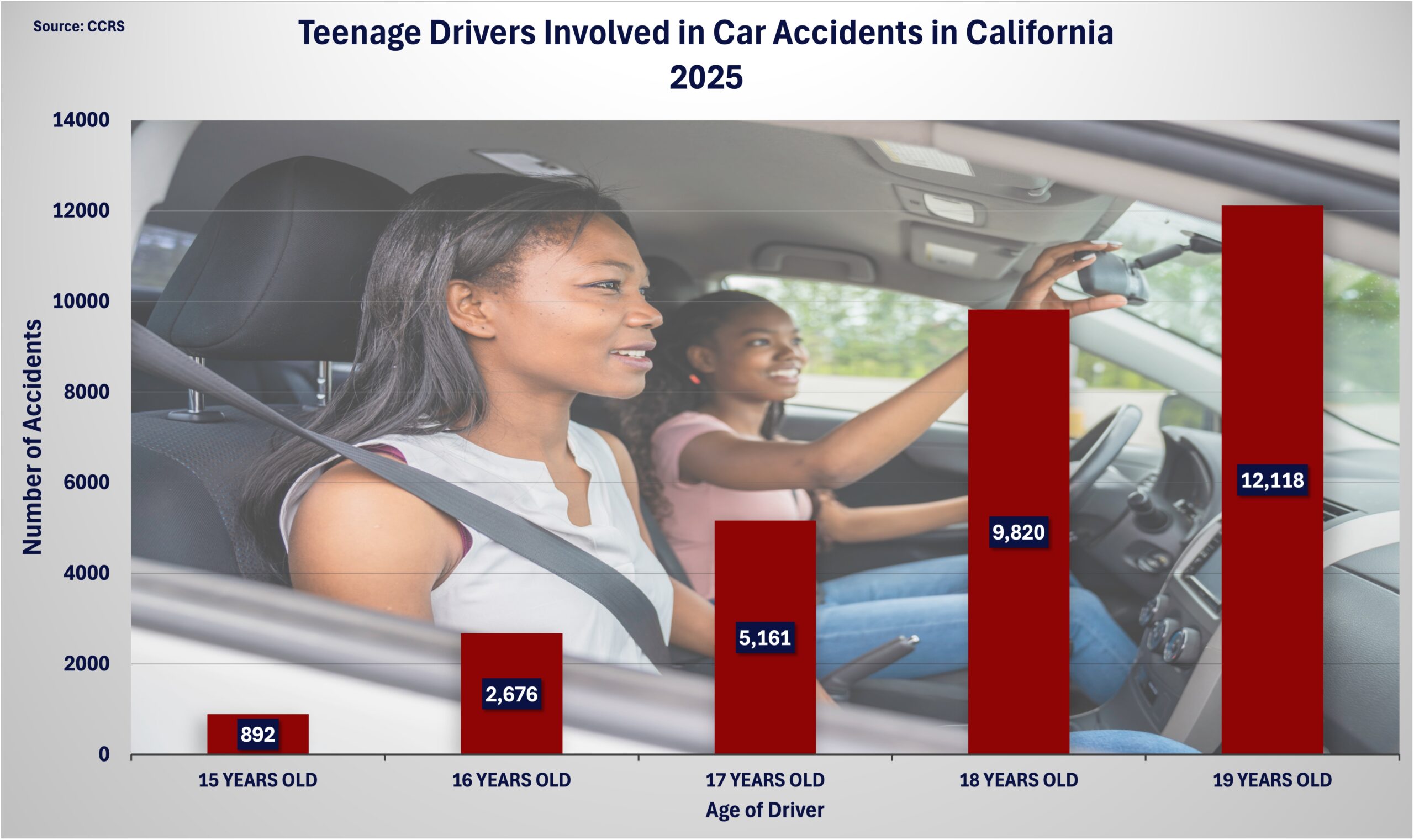
That’s a pretty striking number. Percentage wise, teens accounted for almost 8% of all the car accidents that were reported in California in 2025. But that all changes when you’re the teen that’s in one of these accidents—or more likely, that you have a teen child that’s in one.
Why Are Teenagers in Car Accidents in California?
It’s true that experience is a big factor in car accidents involving teenagers in California, just like it is anywhere else. But it’s far from the only factor. So if you’re a teen driver (or you have one on your insurance policy), here’s a look at the more common reasons why teenagers are in accidents:
- Limited driving experience. As a teen, you’re still learning how traffic flows and how quickly situations on the road can change. Even small mistakes—like turning too quickly or braking too late—can lead to an accident.
- Distractions inside the car. This is probably the biggest factor outside of experience. You can get distracted by your phone or other distractions inside the car while you’re driving. And losing focus for just a split-second can easily lead to a car accident.
- Speed or risk-taking. Other times, you can simply underestimate how quickly a situation can turn dangerous when you’re speeding or making aggressive moves in traffic.
- Driving in unfamiliar conditions. Night driving, heavy traffic, or bad weather can all be more difficult when you don’t have much experience behind the wheel yet.
All of this is pretty standard when there’s a teenager involved in a car accident in California. But when it happens to you—or your teenager—it becomes very personal. At that point, a common question is pretty simple: now what should I do?
What Should I Do Right After My Accident?
Again, when you’re a teen driver and you’re in a car accident, it feels pretty overwhelming. But no matter what kind of accident you’re in or what the other circumstances are, there’s a few steps you should take right after it happens:
- Make sure everyone is safe. The first thing to do is check yourself and anyone in your car. If someone is hurt—even if it doesn’t seem serious—call 911. If the cars are blocking traffic and they can be moved safely, pull them to the side of the road.
- Call the police. In California, accidents with injuries or major damage should be reported. Police officers or the California Highway Patrol (CHP) may come out to the scene and document what happened. Their report often becomes an important record of the accident.
- Exchange information with the other driver. Get the basics from the other driver—their name, phone number, driver’s license number, license plate, and insurance information. You’ll need this if an insurance claim ends up being filed.
- Take photos of the scene. If it’s safe, use your phone to take pictures of the vehicles and the surrounding area. Try to capture the damage, where the cars ended up, and anything nearby that might matter—like traffic lights, road signs, or skid marks.
- Tell your parents as soon as possible. If you’re a teen driver, this is one of the most important steps. Your parents or guardians will probably need to help report the accident to the insurance company and figure out what happens next. Even if the accident seems minor, it’s always better to let them know right away.
- Don’t argue. At the scene, it’s best to focus on exchanging information and speaking with the police. Try not to argue with the other driver about fault. That’s something insurance companies and investigators usually sort out later.
- Get checked by a doctor. Even if you feel fine right after the accident, it’s still smart to get checked out. Some injuries—like concussions or whiplash—don’t always show symptoms right away. Getting medical care early can help catch problems before they get worse.
A car accident can feel like a huge moment when it happens, especially if you’re a newer driver. But focusing on these steps can help you stay calm and handle the situation in a responsible way. This will also make getting information easier, and that’s going to play a big part in a potential claim.
What Information Should I Try to Get After My Car Accident?
One of the most confusing parts of any car accident is knowing what information you need and what you don’t need. And if you’ve never been in one before, it’s hard to know where to start. Generally though, it’s about getting documentation that actually shows what happened and who was involved. Here’s what you can focus on:
- Information from the other driver. Try to collect the basics: their name, phone number, address, driver’s license number, license plate number, and insurance information. This is important if an insurance claim needs to be filed later.
- Witness names and contact information. If anyone nearby saw the accident happen, ask for their name and phone number. Witnesses can sometimes help explain what they saw if there’s disagreement about how the accident occurred.
- Pictures/videos of the scene. Pictures can help capture what things looked like before vehicles are moved. If you can safely do so, try to take pictures/videos of:
- Damage to both your car and the other car
- Where the cars ended up after the accident
- Traffic signals, stop signs, or intersections nearby
- Road conditions, debris, or skid marks
- Police report information. If there are injuries or significant damage, you should call 911. Police or the California Highway Patrol may come to the scene. Ask how you can get a copy of the report, since it usually includes driver information and the officer’s observations about what happened.
- Your own notes about the accident. As soon as you’re able, write down what you remember. Include where the accident happened, the direction each vehicle was traveling, and anything the other driver said. Small details can fade quickly.
- Medical records. Even if you feel okay right after the accident, it’s still a good idea to get checked out by a doctor. Some injuries don’t show symptoms right away, and medical records help connect any injuries directly to the accident.
Remember, you’re not trying to pin blame on anyone with this information. You’re simply trying to get information about what happened. Let our team focus on what comes next: filing a claim and getting help for any injuries or damage.
What Are Some of the More Common Injuries That Could Happen to Me After My Car Accident?
Virtually everybody is aware that car accidents cause injuries. But as a teenager, that might not immediately spring to mind. You probably just want to push ahead and try to move forward. Unfortunately, though, there’s a wide range of different injuries that could happen to you, like:
- Whiplash
- Broken bones, especially at hinge points like your ankles and wrists
- Torn ligaments
- Cuts and bruises
- Traumatic brain injuries (TBIs) and concussions
- Burns
Beyond your physical injuries—which vary widely from accident to accident—there’s also the mental and psychological issues that come from these things. You could also be dealing with anxiety, stress, and PTSD after your accident. But there’s also more practical issues that come from an accident, like an impact on your driving record.
How Long Will My Accident Stay on My Driving Record?
One thing that teenage drivers don’t usually think about with a car accident is how it will impact their driving record or insurance coverage going forward. That’s just part of youth. But there’s realities that come with a car accident in terms of your driving record:
- If you’re considered to be at-fault for the accident, it’ll stay on your record for three years.
- Even if you’re not at-fault, your insurance coverage is going to be impacted. The more claims that get made on the policy, the more premiums are going up. Most teens don’t pay for their own policy right now, but that is going to come into play when you go to get your own coverage.
Even with these realities, one car accident doesn’t define you as a driver. Many people have a minor accident when they’re first learning to drive. What’s important is to learn from your mistakes or errors. From there, though, there’s other aspects that come with a car accident.
What Happens Legally After a Car Accident if You’re a Teen in California?
Legally speaking, there’s no difference between a teenager being in a car accident and anyone else. You can still file an injury claim and recover “damages” for what you’ve lost. And just like anyone else, the options are the same:
- Filing an insurance claim. Most accident cases are handled directly with insurance companies. This process usually moves faster, but the insurance company controls the process and may try to limit how much they pay.
- Filing a lawsuit. In some situations—especially when injuries are serious or fault is disputed—a lawsuit may be filed. While this takes more time, the process is overseen by a judge or jury.
Once your claim is filed, the focus shifts to your “damages.” These are going to be specific to you and what your accident has caused. Generally, though, they can include things like:
- Current and future medical expenses relating to your treatment and recovery costs
- Repair or replacement of your car or other damaged property
- Lost income if you have to miss work or a loss of earning potential if you have long-term injuries
- Pain and suffering
- Emotional distress caused by the accident
- Reduced quality of life during recovery
There’s something important to think about here. You only have two years from the date of the accident to file your claim. Importantly, though, this clock doesn’t start ticking until you turn 18. That gives you some cushion, but with a car accident, it’s usually better to start sooner rather than later.
Who’s Legally Responsible For a Car Accident?
Just like the legal process is largely the same when you’re a teen that’s in a car accident in California, the same goes for figuring out who’s actually responsible. Every licensed driver in California is expected to drive in a way that keeps other people safe.
That doesn’t always happen, as car accident data and conventional wisdom shows. But legally, responsibility comes down to negligence. With that, it could fall on:
- Another driver who made a mistake or broke a traffic law
- A vehicle manufacturer if a defective part contributed to the accident
- A government agency responsible for unsafe road conditions
- A company if the accident involved a commercial or work vehicle
California also uses what’s called “comparative negligence.” That means if you’re found to be partially at-fault for the accident, your damages can be reduced by that same percentage. But one way or the other, if you’re hurt in an accident that you didn’t fully cause, you can file a claim. And you don’t have to go through it alone. Our team will be there to guide you.
What Our Clients Say


Frequently Asked Questions
Sometimes. If the teen was driving a car owned by a parent or guardian, California law allows for vicarious liability, meaning the adult may share some responsibility. This doesn’t always happen, but it’s something families need to understand when an accident occurs.
The first priority is safety. Make sure everyone is okay, call 911 if there are injuries, exchange information with the other driver, and take photos of the scene. And importantly—tell your parents right away. They’ll need to help report the accident and decide on next steps.
In California, you generally have two years from the date of the accident to file a personal injury claim. If you’re under 18, your parents usually handle this timeline, but it’s best to start as soon as possible to gather evidence and protect your rights.
California uses comparative negligence, which means fault can be shared. Even if the teen made a small mistake, they can still recover damages—but the final amount may be reduced based on their share of responsibility.
Can Maison Law Help Me After a California Car Accident?
If you’re a teenager who’s been injured in a car accident—or a parent trying to figure out what to do next—it’s normal to have questions about whether legal help is necessary.
Some minor accidents can be handled directly through insurance. But when injuries are involved or there’s disagreement about what happened, the process can quickly become more complicated. That’s where having a legal team can help. At Maison Law, our team can:
- Walk you through your options and explain what comes next
- Look closely at accident reports, photos, and medical records
- Gather the evidence needed to understand what happened
- Work with medical or accident experts if needed
- Handle talks with insurance companies
Our team at Maison Law will be with you and your family from the beginning. Set up a free consultation today to get started.