Home » The True Cost of Commuting: How Stressful Travel Impacts Americans
The True Cost of Commuting: How Stressful Travel Impacts Americans
For millions of Americans, the workday doesn’t start at the office, it starts in traffic.
New data measuring commute stress across the United States paints a striking picture: for some, getting to work is more exhausting than the job itself.
How We Measured Commute Stress
To create this analysis, we surveyed 1,828 people across the U.S., ensuring at least 35 respondents from all states except Alaska, Maine, Montana, North Dakota, Rhode Island, South Dakota, Vermont, West Virginia, and Wyoming, which were therefore not included.
From these data points, we calculated a commute stress score for each state using a weighted formula that included the following:
Being reprimanded or late due to traffic: 3%
Missing meetings or deadlines because of traffic: 3%
Feeling drained before the workday: 2%
Too tired to focus on work: 2%
Regularly arriving stressed: 7%
Changing routes to avoid stress: 6%
Being in a traffic accident: 8%
Encountering near accidents: 8%
Saying commute is more stressful than the job: 9%
Categorizing commute as very stressful: 10%
Mean commute time: 6%
Not working from home: 5%
Vehicles involved in fatal crashes (morning): 5%
Vehicles involved in fatal crashes (evening): 5%
Average minutes to travel 6 miles during peak traffic: 7%
Average congestion levels: 7%
Hours lost per year during peak rush hour: 7%
States With the Most and Least Stressful Commutes
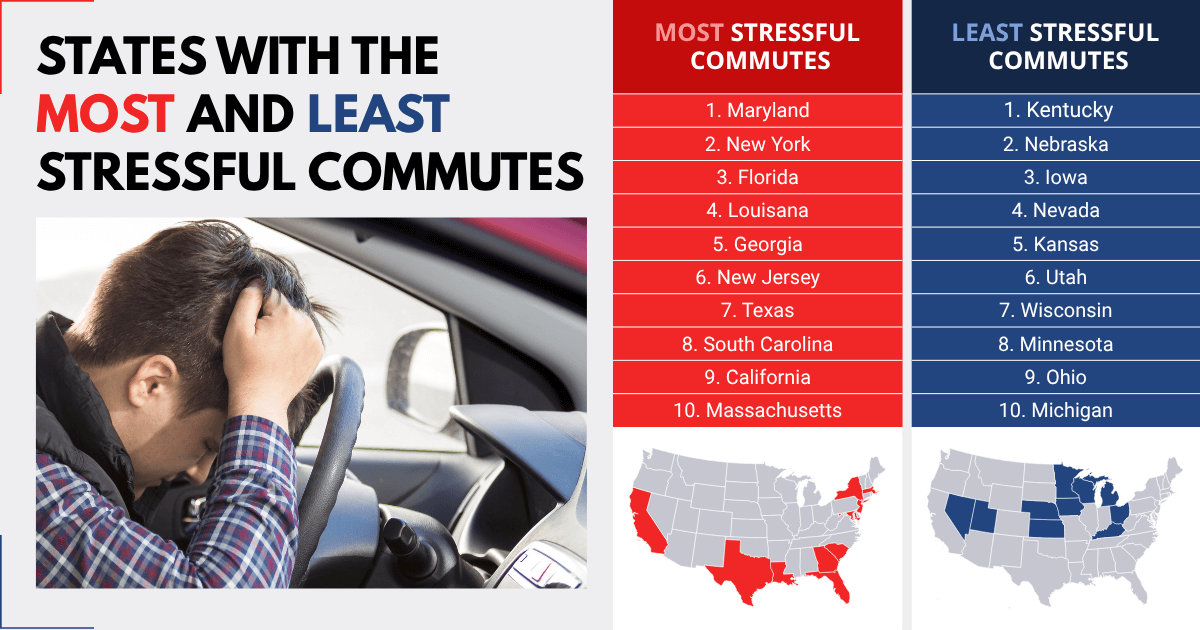
Maryland tops the stress index with a score of 230.9, followed by New York (228.9), Florida (227.9), Louisiana (226.5), and Georgia (222.4). In contrast, Kentucky (142.4), Nebraska (160.0), and Iowa (161.4) have the lowest stress scores, showing that geography and the density, infrastructure, and traffic patterns of a region strongly influence commuting stress.
Who Feels It Most?
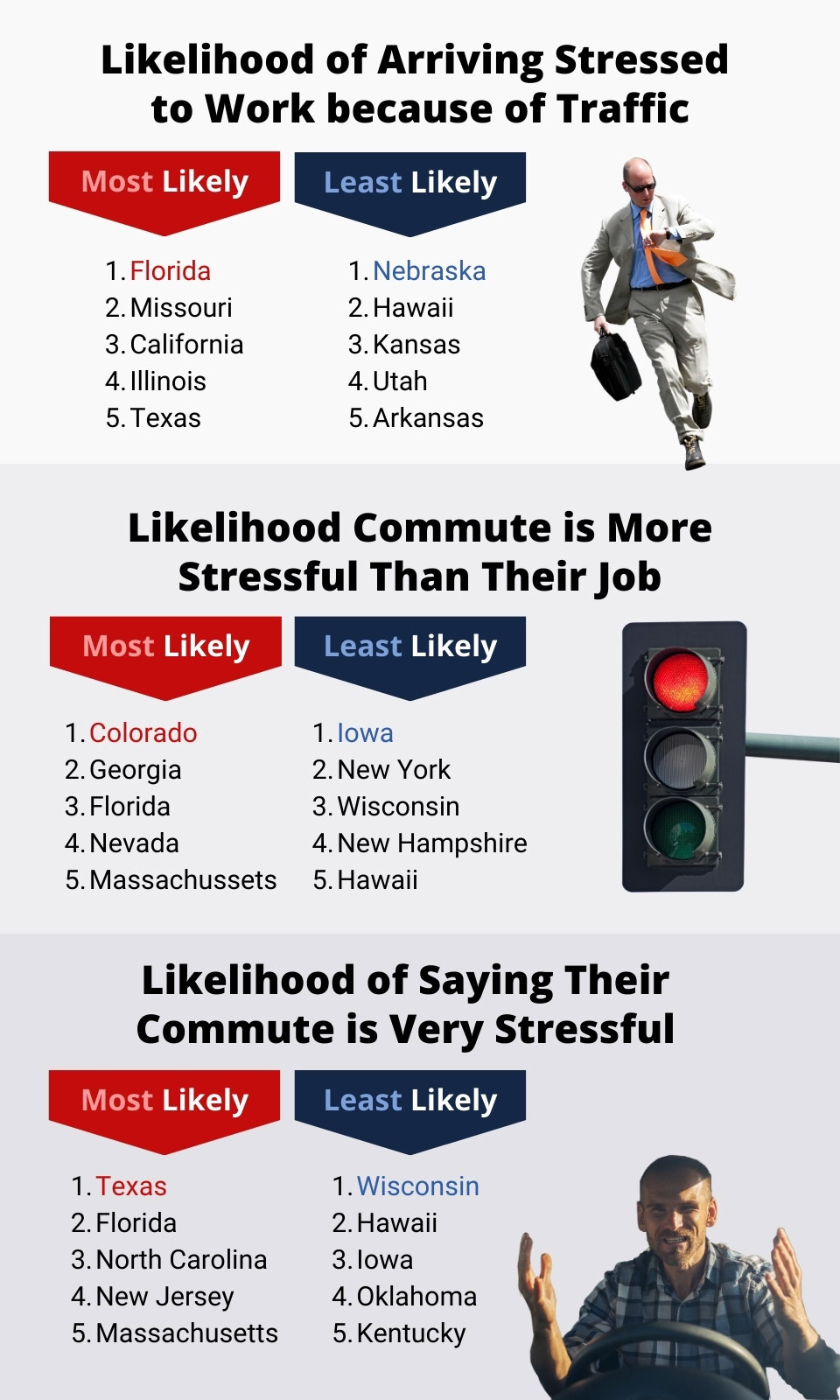
Stress isn’t just measured in numbers, it’s about lived experience. Florida, Missouri, and California lead the nation in the likelihood of arriving at work stressed because of the commute, while Nebraska, Hawaii, and Kansas are least likely to report stress.
Commuters in Nevada and Missouri are most likely to change their route to avoid stress, whereas Washington and Kentucky see the fewest route changes. Additionally, in states like Colorado, Georgia, and Florida, workers are more likely to report that their commute is more stressful than the job itself, while Iowa, New York, and Wisconsin are least likely to say the commute outweighs the workday.
Time in Traffic Matters
Commute length is closely tied to stress.
The longest mean commute times are in New York (32.8 minutes), Maryland (31.5), New Jersey (30.9), Massachusetts (29.3), and California (29).
States with the shortest commutes, including Kentucky (14 minutes), Nebraska and Nevada (19.1), and Iowa and Kansas (19.8), align closely with the lowest stress scores.
More time on the road often means more stress, less sleep, and less personal time.
What People Are Losing
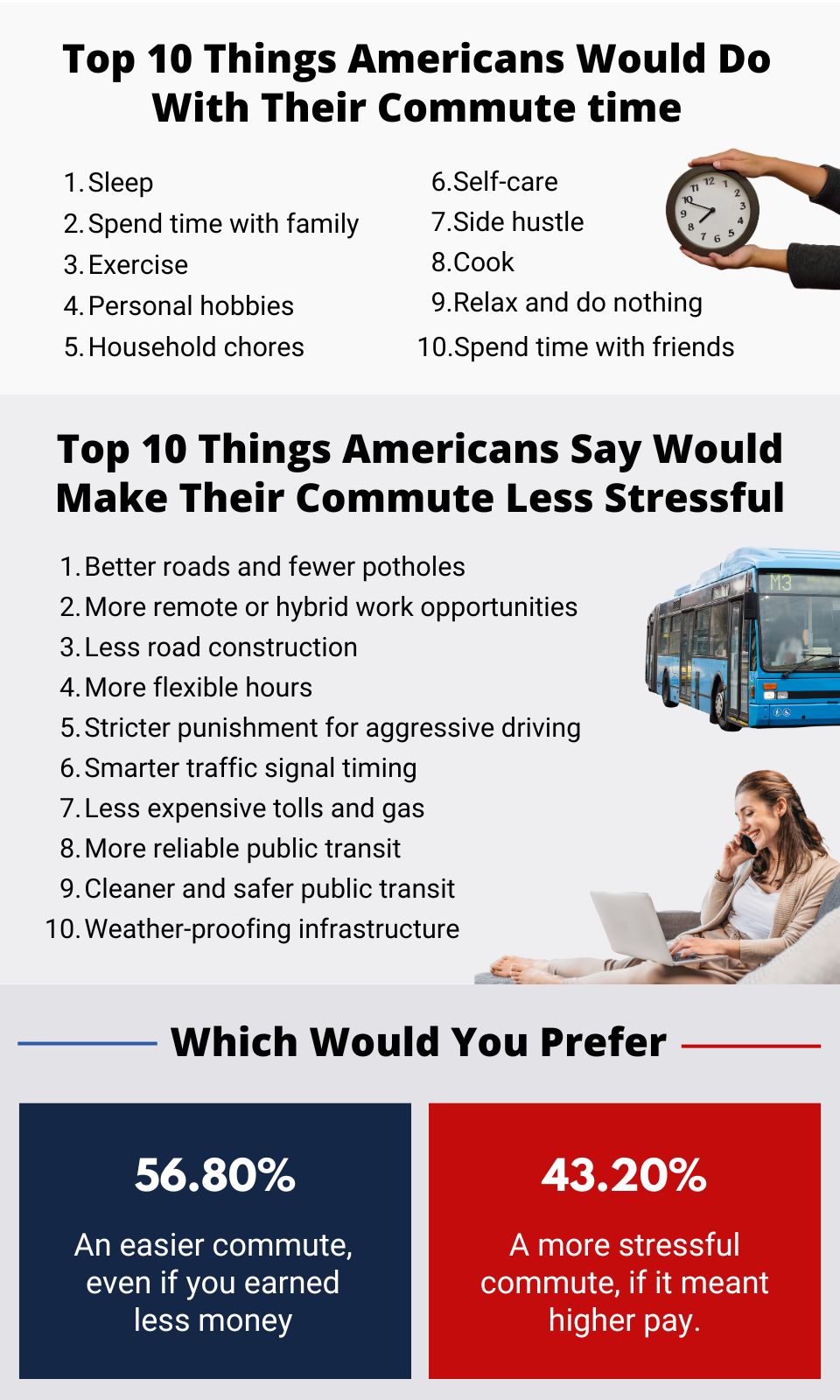
If commuters could reclaim their travel time, most would prioritize:
Sleep: 68%
Family time: 46%
Exercise: 40%
Personal hobbies: 38%
Household chores: 34%
Self-care: 32%
Only 16% would dedicate extra time to work, highlighting the lost opportunity for personal wellbeing caused by long or stressful commutes.
How Commuters Want Relief
When asked what would reduce commute stress, respondents prioritized:
Better roads/fewer potholes: 42%
More remote/hybrid opportunities: 41%
Less road construction: 39%
More flexible work hours: 32%
Stricter punishment for aggressive driving: 32%
Smarter traffic signal timing: 30%
Lower tolls, cleaner transit, and safer bike/pedestrian infrastructure were also mentioned, emphasizing both systemic and personal interventions.
Choosing Less Stress Over Higher Pay
When faced with a trade-off, 57% of Americans would choose an easier commute even if it meant lower pay, while 43% would accept a more stressful commute for higher earnings.
Commuters clearly value quality of life and reduced stress over financial gain.
Choosing Less Stress Over Higher Pay
Whether it’s 32 minutes crawling through New York traffic or 14 minutes cruising in Kentucky, commuting is more than lost time, it’s lost sleep, lost health, and lost opportunities for personal fulfillment.
Commuting stress isn’t just a matter of lost time and fatigue, it can also have legal implications. Traffic accidents during the daily commute can lead to injury claims, insurance disputes, or liability questions.
For workers navigating these challenges, Maison Law can provide guidance and support to ensure rights are protected in the event of accidents or workplace repercussions tied to commuting delays.