The clocks are falling back and that means more people will be heading home from work while it’s already dark outside.
With darker rush hours hitting drivers suddenly, data shows an alarming trend. Bicyclists and pedestrians in multiple California counties get injured or killed more in low light (dusk or darkness) after the clocks turn back in the fall.
WHY THE TIME SWITCH MATTERS
When the clocks turn back on Sunday, Nov. 1, drivers will be on the road during peak travel hours in the dark. While it’s an adjustment many drivers get used to after a while, it can be a big switch during those first couple weeks.
In Los Angeles, the sun sets at 6:02 p.m. on Oct. 30 this year according to the NOAA Solar Calculator. That’s a couple days before daylight saving ends. That first Monday after the time switch happens on Nov. 2, sunset arrives much earlier at 4:59 p.m.
That means for commuters, those 5 p.m. traffic jams are in significantly lower light than they’re used to only days prior.
Cyclists and pedestrians are already harder to spot in afternoon daylight than cars. Darker evenings create even more of a hurdle.
WHAT THE DATA ACTUALLY SAYS
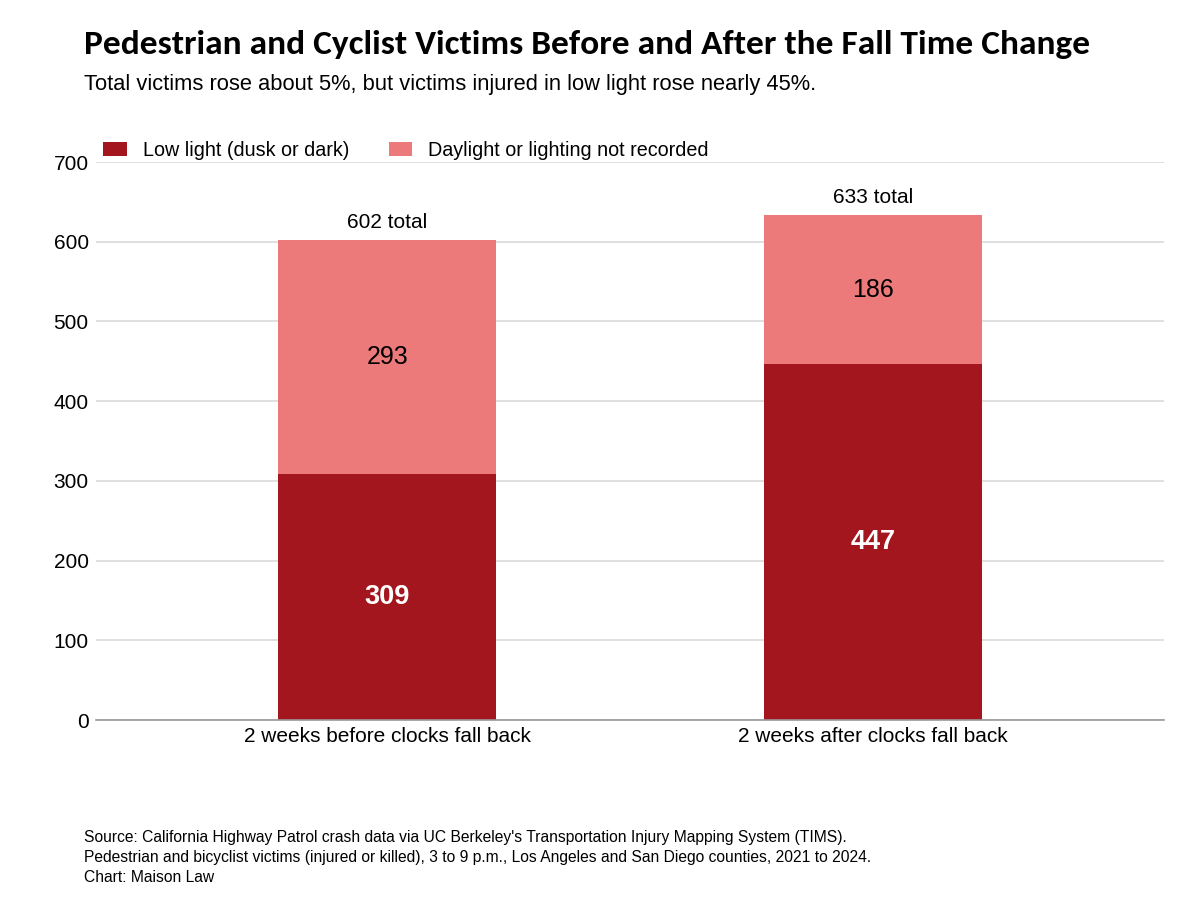
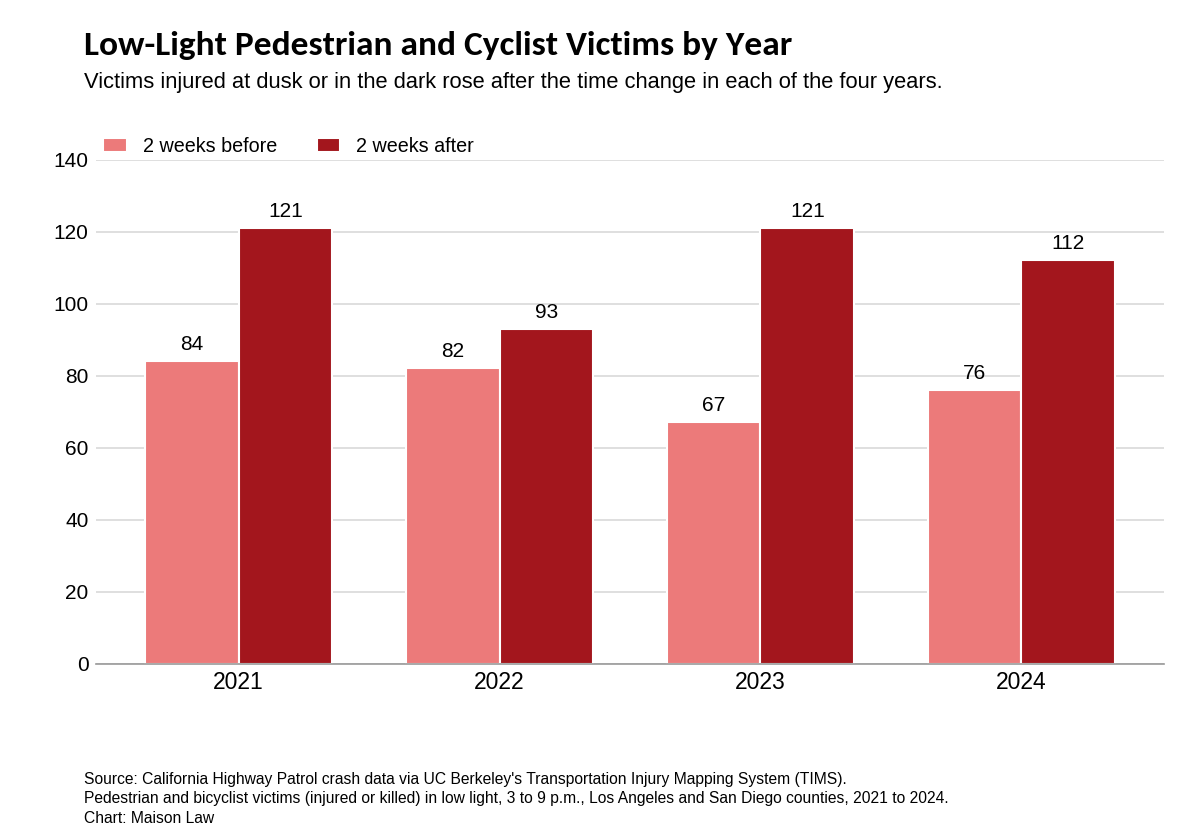
We looked at data from the California Highway Patrol through UC Berkeley’s Transportation Injury Mapping System (TIMS). We examined the number of pedestrians and cyclists injured or killed in Los Angeles and San Diego counties between 3 and 9 p.m. Our research highlights the difference in the volume of pedestrian and bicycle victims during the last two weeks before daylight saving ends and the first two weeks after the time change. Our research shows data from years 2021 to 2024.
Data shows that for both counties combined, there is a 5% increase in the total number of pedestrians and cyclist crash victims after the time switch compared to the two weeks before the time change. That increase doesn’t account for light conditions. That means for the complete number of victims, there’s only a slight change after the sun goes down earlier.
While the total number of victims only rises by 5% after the time change, the increase in the number of victims injured specifically in low light (dusk or darkness) is much higher and more concerning.
The two counties combined show a 45% increase in the number of pedestrian and cyclist victims injured specifically in low light after the time change compared to before. That’s a much higher spike than the 5% rise in victims when light conditions aren’t accounted for. The number of victims injured or killed particularly in dusk or darkness increased across all four years we examined.
That means there’s far more people getting killed or injured in low light when it gets darker outside earlier.
It’s not just here in California. A national study by the Insurance Institute for Highway Safety (IIHS) looked into fatal crashes over the five weeks following the time change. The study showed a 13% increase in fatal pedestrian and bicyclist crashes after daylight saving ended.
WHAT DOES ALL THIS MEAN?
Even though the data from Los Angeles and San Diego counties show only a slight increase in the total number of pedestrian and bicycle victims after daylight saving ends, there’s more to the story when light conditions are accounted for. Both local data and a national study suggest darker road conditions at peak travel hours can create added danger for some of the most vulnerable people on the road.
SAFETY TIPS
If you’re someone who enjoys walking outside, the San Diego Police Department has some tips to help you avoid becoming another statistic.
Police remind the public to:
- Be predictable and use proper crosswalks
- Watch for oncoming vehicles and be careful crossing the street
- Make it obvious for drivers to see you when it’s dark by wearing light colors, reflective material and keeping a flashlight
- Be careful crossing the street or using crosswalks at night or on busier streets with higher
speed limits
IF YOU’RE INJURED
The most important things to do after an accident:
- Seek medical attention immediately, even if you feel okay — some injuries don’t present symptoms right away
- Document everything: photos of the scene, your injuries, any vehicles or objects involved
- Get contact information for witnesses
- Do not give a recorded statement to an insurance company before speaking with an attorney
- Contact a personal injury lawyer as soon as possible — California’s statute of limitations means waiting too long can cost you your right to recover
HOW MAISON LAW CAN HELP
At Maison Law, we represent people injured in car accidents, DUI crashes, pedestrian accidents, and other incidents caused by someone else’s negligence. Our clients don’t pay anything unless we win their case.
Founding attorney Martin Gasparian has recovered millions of dollars for injury victims across California — from major freeway accidents to neighborhood crashes that insurance companies tried to minimize or deny.
If you or someone you love is hurt on the road, call us at 866-383-8922 or reach out online. Consultations are free, confidential, and available 24/7. We represent clients in English, Spanish, and multiple other languages.
No fee unless you win.
Journalists with questions about the data or methodology are encouraged to reach out directly to Christopher Cooke at (252) 799-7258 or chris@optimizemyfirm.com.
This report is for informational purposes only and does not constitute legal advice. Data sources include California Highway Patrol collision records (2021–2024), Insurance Institute for Highway Safety (IIHS), UC Berkeley TIMS, NOAA, SDPD.