
There’s no greater responsibility on the road than keeping young passengers and teen drivers safe.
This duty comes into play when states must decide when young drivers earn the privilege of holding a full driver’s license. This important determination is for the safety of inexperienced drivers and for the safety of all others on the road.
These laws govern when a teenager is allowed to drive with supervision and when they are granted the responsibility to venture out on their own.
The Graduated Driver Licensing System for Teen Drivers
The 50 states all use some form of the Graduated Driver Licensing (GDL) system. It’s a set of rules, requirements, and restrictions that allows hopeful drivers to get experience on the road before obtaining an unrestricted driver’s license.
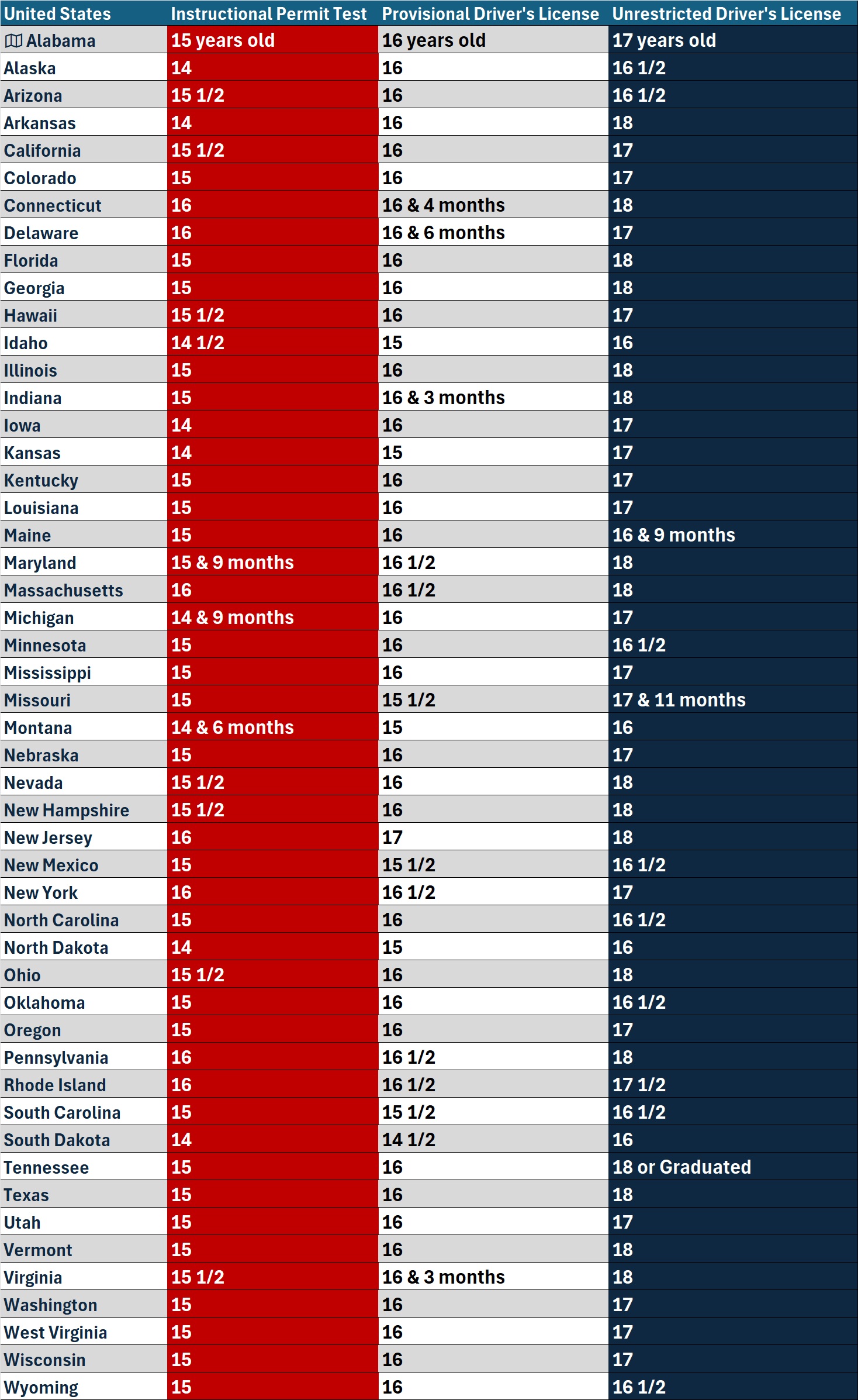
The ages at which young drivers can obtain a learner’s permit and when they are awarded a full-fledged license can differ by months and years among states.
In all states, new drivers are allowed to get a learner’s permit or instructional permit at perhaps 14 or 15 years old. This allows them to drive with an adult driver beside them. Testing, driving school, and a certain amount of time logged behind the wheel may be a part of the process.
When drivers meet the requirements and, in some cases, reach a certain age, they can get a provisional license. This license is called an intermediate license in some states. Some restrictions are lifted, and some solo driving may be allowed. At 16, 17, or 18, drivers will be allowed to try for an unrestricted driver’s license.
Below is a list of the minimum ages for teen drivers getting the different versions of driver’s licenses in each state.
Please note that some states grant a full driver’s license at 16 and 17 years old, but some teen restrictions remain until 18 or even 21 (e.g., no cell phone use).
Driving Restrictions for U.S. Teens
Each stage of the GDL process comes with different restrictions for teen motorists. These are just a few of the requirements and restrictions that are applied to young drivers in many states:
- No cell phone use other than in emergency situations
- Restrictions on the number of passengers
- Restrictions on the age of passengers
- Restrictions on night driving
- Restrictions on highway driving
- For teens living in rural communities, driving ages may be lowered
- Requirement of a clean record throughout to get a full license
- No solo driving unless it’s a trip to school or to work
Some restrictions may persist even after a so-called “full-license” is awarded. In some states, young drivers are still restricted from using cellphones until they are 18 or even 21.
For more information on the progression for teen drivers in California, please visit our informational page.
Protecting Teen Drivers in California
Teen drivers can be more careless and even a bit reckless when they first pull out onto a California boulevard or freeway. Yet, that doesn’t mean they are responsible for every accident.
Teens can be struck by a driver of any age and left with serious injuries. It’s important to make sure the blame stays with the other driver and that your child gets enough in an injury claim to pay for a full recovery.
Contact a California car accident lawyer if your teen driver is hurt in an accident and another driver is to blame. We offer a free consultation to all victims. And if you need our help to clear your teen of blame and secure full support for injuries, you don’t have to worry about the cost of a lawyer. Maison Law doesn’t charge anything unless we win your car accident case. Then we are paid out of the settlement you receive from a car insurance company.
